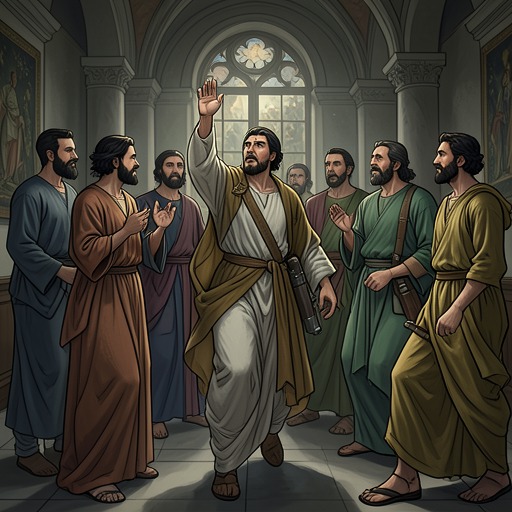
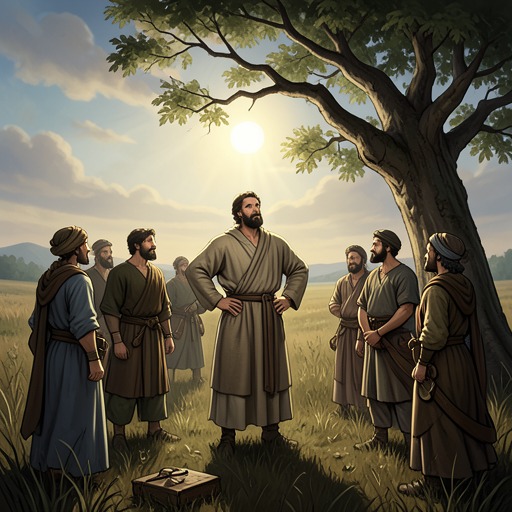
Jesus's solitary prayer before public ministry
Don't Leave God Alone: How to Get God's Attention, Remain in His Presence, and Even Change His Mind to Make a Difference in Your WorldJesus's solitary prayer before public ministry is the book's clearest model of how hidden devotion becomes visible authority. Jesus withdraws from people and distraction to pray alone with God, and the power that appears afterward—in healing, deliverance, blessing, and resistance to the devil—is portrayed not as an isolated spectacle but as the public fruit of private communion.
Withdrawal and Spiritual Preparation
Jesus repeatedly separates himself from the crowds before exercising public ministry. In Luke 5, he withdraws into the wilderness and prays; in Luke 6, he goes onto a mountain and continues all night in prayer to God. These scenes establish solitude not as inactivity but as preparation. The withdrawal creates a concealed interval in which Jesus gives himself fully to God before returning to the needs of the people.
The pattern also defines prayer as an intentional refusal to let competing obligations control the day. The book describes private prayer as the place where distractions are shut off and spiritual power is received. It connects this principle with the author’s own determination to maintain prayer in fields, forests, garages, tents, cabins, sheds, cars, and other secluded places. The locations vary, but the governing action remains the same: Jesus and those who follow his example seek God before attempting to display power before others.
Public Results of Hidden Prayer
The Gospel accounts place concrete results immediately beside Jesus’s periods of solitude. After the wilderness prayer in Luke 5, a paralyzed man is brought before him when the crowd blocks the ordinary entrance; the man is lowered through the roof on his bed so that Jesus can minister to him. After Jesus spends the night praying on the mountain in Luke 6, people troubled by unclean spirits are healed, and the whole multitude seeks to touch him because power goes out from him and heals them all.
The sequence is therefore causal within the book’s interpretation: Jesus prays in secret, then acts with power in public. Healing, deliverance, and blessing are not treated as disconnected gifts but as manifestations following sustained communion with God. The principle is condensed in the teaching that the Father sees what is done in secret and rewards it openly. Private prayer produces public results because the hidden encounter becomes an outward ministry capable of meeting the crowd’s needs.
Prayer Before Temptation and Conflict
Solitary prayer also prepares Jesus for confrontation rather than only for benevolent acts. In Luke 4, Jesus is led into the wilderness to be tempted by the devil. The book explains that his time alone with God taught him how to overcome temptation, and that he emerges from the wilderness in the power of the Spirit, after which his fame spreads throughout Galilee.
This movement gives the action a second function. Prayer does not merely precede miracles; it forms the strength required to withstand spiritual opposition. The wilderness is consequently both a place of separation and a testing ground. Jesus enters it after private communion and leaves it with public power, making the passage a pattern of preparation, conflict, victory, and renewed ministry.
A Pattern for Individuals and Churches
The book extends Jesus’s practice beyond his own life into a rule for believers and congregations. It states that those who depart from public activity to be alone with God are later seen operating in tremendous power, and it calls prayer a secret weapon. The author recalls spending extra time fasting and praying before a conference where the power of God was experienced throughout a crowded auditorium, with ushers and entire sections of people falling and shaking under the anointing. The event is interpreted through the same sequence as Jesus’s ministry: heightened private prayer precedes intensified public manifestation.
The principle is also applied to collective persistence. The early church in Acts 12 is praised because it did not let go of God when Herod killed James and imprisoned Peter. Rather than relying on natural political or public strategies, the church responded through diligent prayer. In the book’s wider framework, Jesus’s solitary prayer supplies the personal pattern, while the praying church supplies its communal extension: hidden persistence becomes the means by which a threatened ministry continues.
Theological and Narrative Significance
Jesus’s solitary prayer before public ministry joins inward devotion to outward consequence. It presents spiritual authority as something cultivated before it is displayed, and it makes the order of events significant: solitude comes before service, prayer before power, and preparation before confrontation. The action also provides the book’s standard for evaluating Christian effectiveness. A ministry that seeks public results without sustained private prayer is implicitly deprived of its proper source.
The recurring contrast between the secret place and the public multitude gives the motif its force. The wilderness, mountain, and closed room appear outwardly removed from ministry, yet they are where ministry is prepared. Jesus’s public reputation, the healing of the afflicted, the deliverance of those troubled by unclean spirits, and his victory over the devil all point backward to the hours no crowd witnessed. In that structure, prayer is not an interruption of the work; it is the hidden work from which the visible work receives its power.